Tequila Mockingbird’s Punk Museum

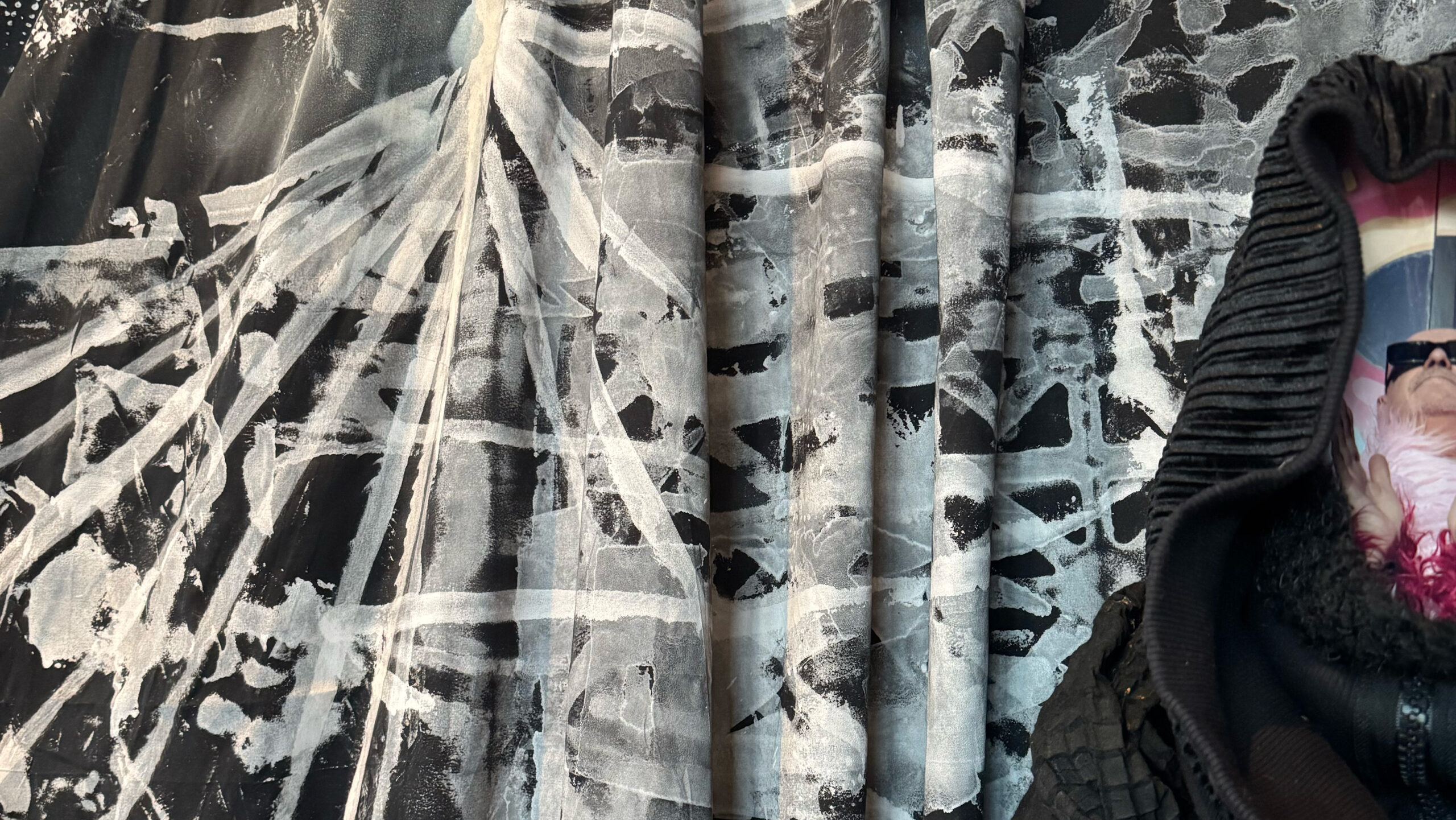
There is a corner of MacArthur Park where fifty years of Los Angeles punk currently hangs on the walls, and some of it is ours. Walk into the Goethe-Institut’s project space this fall, where Tequila Mockingbird’s Punk Museum is on view through October 7, and our contribution is the corner that goes vertical: garments mounted as high as the ladder would reach, black cloth streaked and splattered with white, a red shroud of torn crochet presiding at the top where the wall runs out. We were asked for a display. What we built is closer to an altar.
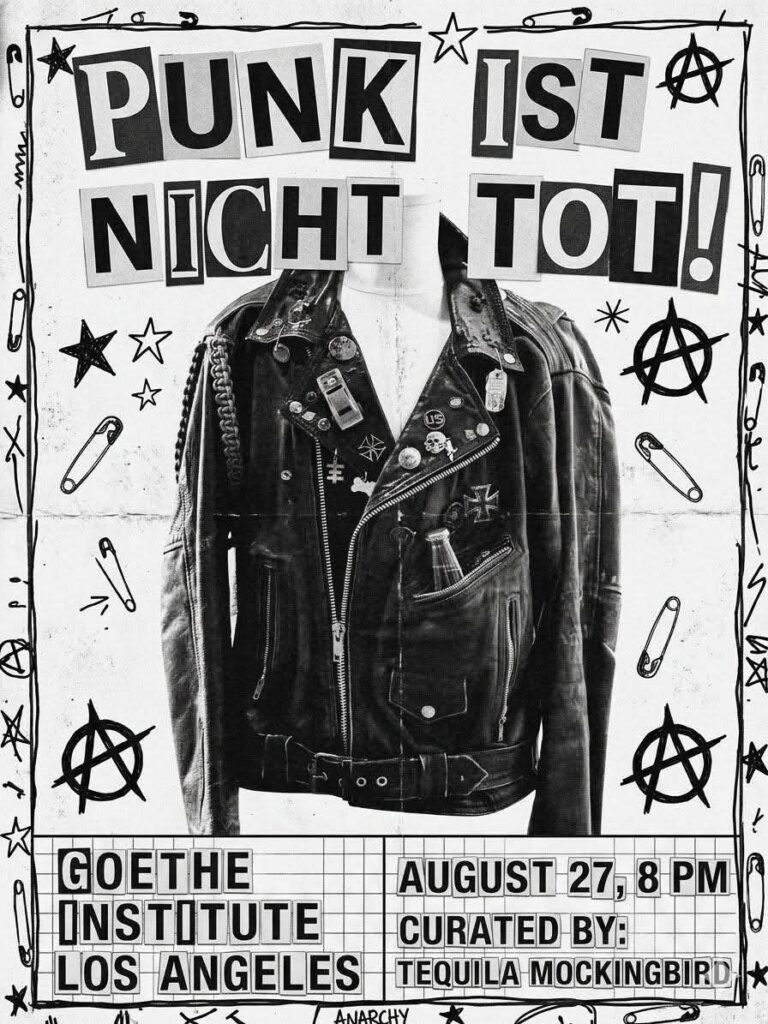
Punk ist nicht tot! - Goethe Institute Los Angeles.   August 27th 8PM.  Curated by: Tequila Mockingbird

The invitation came through Tequila Mockingbird, whose Punk Museum sits at the heart of the Institut’s Alle gegen Alles. Punk@50 programming: an exhibition assembled not from acquisitions but from a life spent inside the scene, tracing Los Angeles punk alongside its German and European counterparts. There is something fitting about a German cultural institute hosting this. Punk was never a local dialect; it was a correspondence, carried on across oceans by records, zines, and badly photocopied flyers, and fifty years on the Goethe-Institut has chosen to answer the mail.

The brief was Edward’s clothing, five decades of it. Rather than dress a row of mannequins, we treated our section as an installation: the work climbs the wall in a single accumulating figure, with veiled and hooded forms gathered at its base, one in a beaded lace mantilla, one hung with crosses and straps. The photographs sit at the foot of it all, framed and leaned the way offerings collect at the base of a shrine, and the topmost garment fans out across the corner, claiming as much wall as the building would concede. The reference we kept returning to was Saint Brigid, who asked the King of Leinster for only as much land as her cloak would cover, then spread that cloak across the Curragh of Kildare. Edward left Dublin as a boy. The saints travel with you whether you ask them to or not.
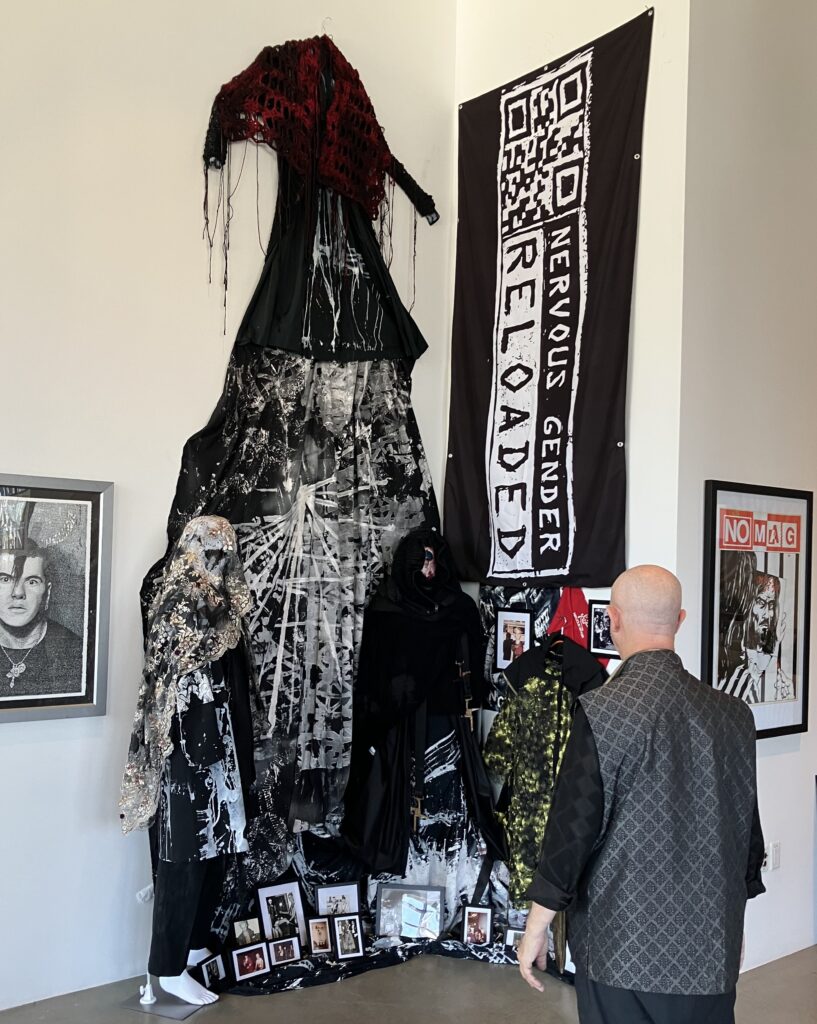
And every altar wants a relic. Ours is not a metaphor: one of the hanging suits is encrusted with fifty years of spit, accumulated a stage at a time since the era when gobbing was how an audience said thank you. We spent the opening night telling visitors this, and watched each of them lean in for a closer look, then quietly reconsider the distance.
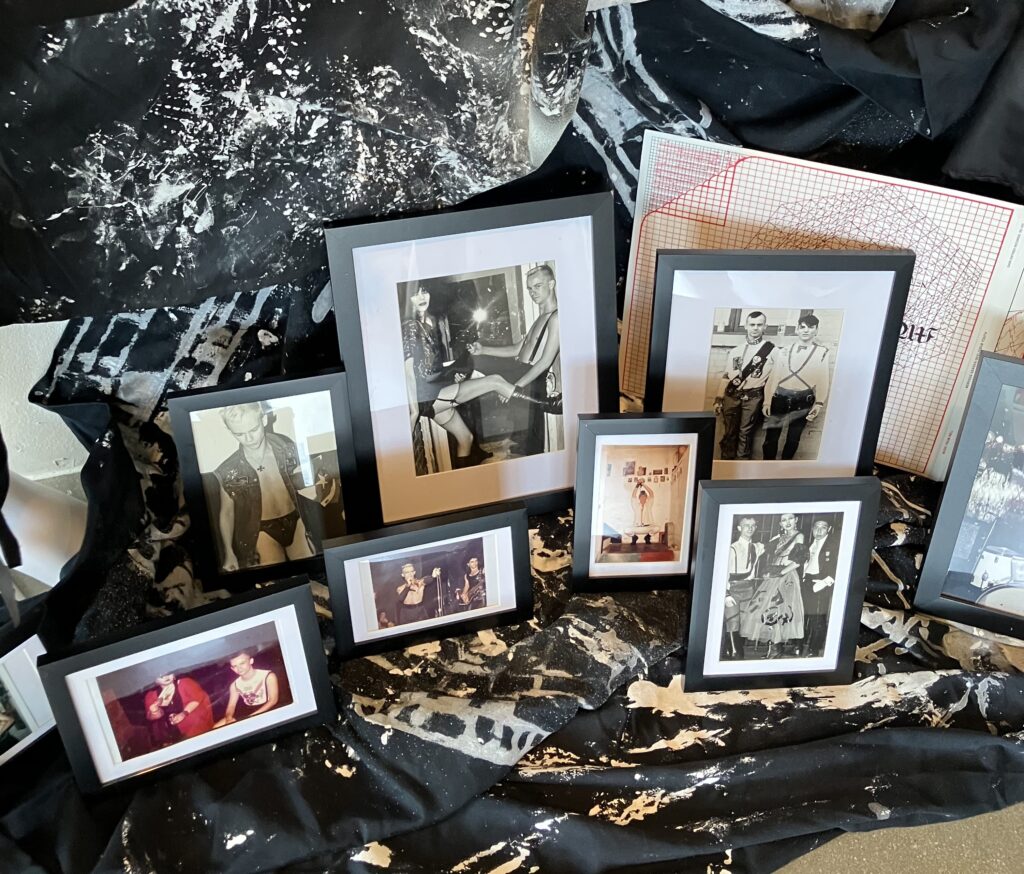
The pieces span the design room at Poseurs on Sunset, the surrealist work sold through Neo 80 and Tiger Rose, the proto-goth years at Black Salad, and the stage wear of the current lineup. The thesis, in Edward’s words, is that punk gave a generation a shared language of dress, and languages invite dialects. This corner is one designer’s dialect, spoken continuously for fifty years, from the era when Nervous Gender was confrontation in a club to the present, where Nervous Gender Reloaded carries the argument forward with no constraints left on it.
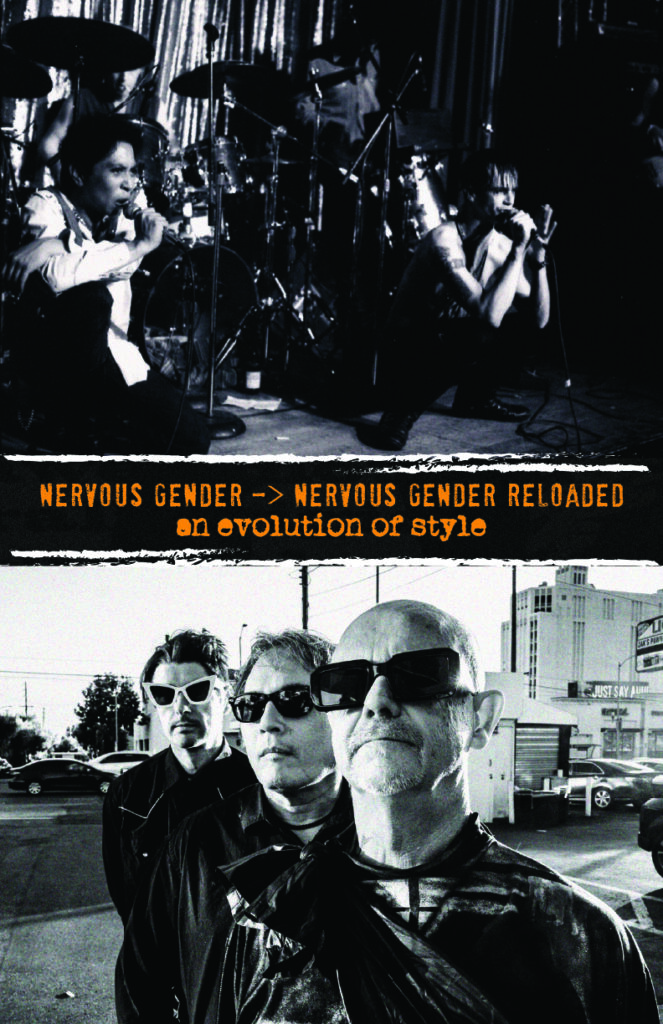
Nervous Gender -> Nervous Gender Reloaded: an evolution of style booklet

Alongside the installation we produced a booklet gathering the photographs and the story behind them, with images by Wild Don Lewis, Edward Colver, Karin Lindberg-Freda, @venom_verbatim, Bumbdog Torres, Doug Moore, Sydney Rose, and others whose names the decades have misplaced. The topmost image on the cover is Wild Don Lewis’s. The booklets sit on a collection plate at the foot of the display, free for anyone to take. This may be the only altar in Los Angeles where the plate pays you.
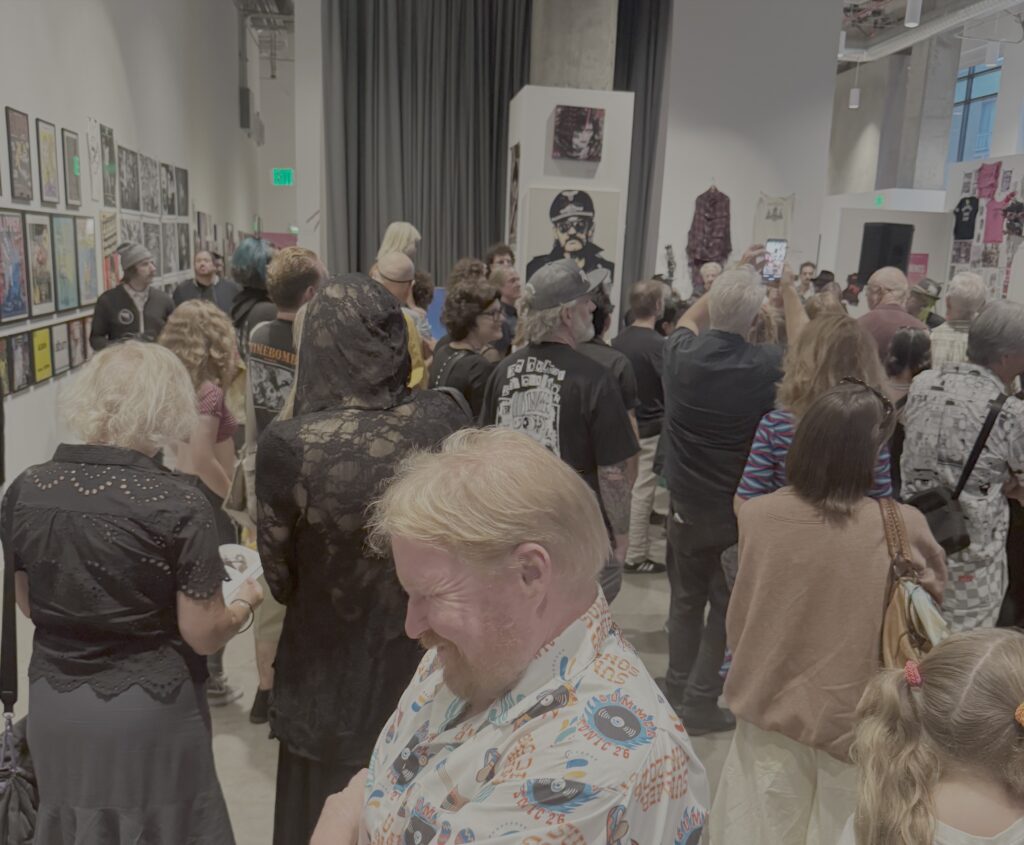
The opening filled the gallery to its walls, and it deserved an afterparty. We played Deep House Design/RetailSlut alongside Atomic Kangaroo, and if the name rings a bell, it should: Retail Slut dressed the Melrose underground for over twenty years, which made it the correct place to take a fashion exhibit off its mannequins and put it back on bodies. The installation shows what the clothes look like standing still. The afterparty was a reminder of what they are for.

Tequila Mockingbird’s Punk Museum is on view at the Goethe-Institut Los Angeles Project Space in MacArthur Park through October 7, 2026, free during office hours. Fifty years of this and nobody has managed to make us presentable.

A Light in the Room: A Benefit for the Gregg Foreman Trust

Ravens Moreland, Nervous Gender Reloaded, Sylvia Black, and Harry Cloud at the Monty Bar

Gregg Foreman was the kind of musician other musicians knew. Born in Philadelphia on October 5, 1972, raised in Valley Forge, he bought his first synthesizer (a Roland Alpha Juno) and a Yamaha drum machine at thirteen, and spent the rest of his life turning that early fixation into a working practice. He died at home in Los Angeles on April 21, 2026, at fifty-three.

Between those two dates, Gregg ran a circuit through underground music that would be hard to retrace even if you’d been there for all of it. He founded The Delta 72 in the mid-90s, a post-punk/soul/no wave band that released records on Dischord, Kill Rock Stars, and Touch and Go, working with Brendan Canty, Eli Janney, Steve Albini, Royal Trux, and Shelly Yakus before disbanding in 2001. He played on Acme by the Jon Spencer Blues Explosion. He joined Cat Power in 2006 and became musical director for Chan Marshall’s band, a partnership he once summed up to LA Weekly as “what was meant to be two weeks is now going on ten years,” and he held that role for the rest of his life. Along the way he played in Pink Mountaintops, The Meek, The Black Ryder, and The Silver Chords; he toured Europe with The Gossip in 2019, including Madrid’s Mad Cool festival; he released a 2019 EP with Suicide’s Alan Vega featuring Nick Zinner, White Hills, Jim Sclavunos, and JG Thirlwell; he contributed to James Williamson’s 2015 Re-Licked project alongside Alison Mosshart, Bobby Gillespie, Jello Biafra, and Mark Lanegan; he played in Justin Warfield’s band Warfield; he scored live with Martin Rev; and from 2020 onward he served as bandleader and synth player for Kat Von D across Love Made Me Do It and 2024’s My Side of the Mountain. In 2023 he toured with Lydia Lunch and Sylvia Black on Trust the Witch.

Known professionally as Mr. Pharmacist, a nod to his self-described “Moth” aesthetic blending Mod and Goth, Gregg built a reputation as a versatile keyboardist and bandleader spanning punk, post-punk, indie rock, and electronic music. In his later years he was producing live scores to underground, strange art, and obscure films at the Philosophical Research Society, working with Death Valley Girls, Martin Rev, David J, Eugene Hütz, and Paris Jackson. He ran a freelance writing beat for the Philadelphia City Paper in the ’90s, interviewing musicians like Ian McLagan and Bobby Byrd, and his obsession with 45s led him to start a mod/soul residency in Philadelphia called The Turnaround, a formative party that helped seed what became David Pianka’s long-running Making Time. From there he DJed worldwide, including David Lynch’s Silencio in Paris, Le Baron, and Tokyo’s Beat Cafe. His radio show, also called The Pharmacy, interviewed everyone from Genesis P-Orridge to Damo Suzuki to ? of ? and the Mysterians, a separate vocation he treated with the same scholarship.

He was also, in a particularly LA way, a curator of other people’s songs. Gregg put on tribute shows for the artists he loved, gathering local players to inhabit the catalogs that had shaped him. Ravens Moreland’s Bruce Moreland sang on a Birthday Party / Bad Seeds tribute Gregg organized, and again at a Suicide tribute, two of the most demanding songbooks in post-punk and a credible measure of who Gregg trusted with them. The 2018 Alan Vega memorial concert at Bowery Electric in New York found Gregg backing JG Thirlwell on “Harlem,” part of the same lineage of work: Gregg as the engine that let other people stand in front of songs that mattered.

He was, by every account that’s surfaced since April, the connector. “He was the light and love and everything,” his sister Abbe said. “Everywhere he went, he brought love and light, and he was so talented.” Cold Cave’s Wesley Eisold put it more bluntly: Gregg “lived a life that others only claim to have lived.”

This benefit gathers a slice of the community that grew up around him. Ravens Moreland, Bruce Moreland’s current project with roots stretching back through Wall of Voodoo, the Weirdos, and Nervous Gender, anchors a bill that also features Nervous Gender Reloaded, Sylvia Black (who toured with Gregg as part of Lydia Lunch’s Trust the Witch in 2023), and Harry Cloud. Proceeds support the Gregg Foreman Trust.

Come for the music. Stay for the room he made possible.

The Monty Bar, 1222 W 7th St, Los Angeles.

Fat Gender Fuck

Michael Intriere is a Los Angeles cellist and composer whose work spans the outer edges of punk, free improvisation, and avant-garde classical music. He co-founded Fat and Fucked Up in the 1980s alongside Josie Roth — a “thrash-classical chamber group” whose membership fluctuated and whose approach to improvisation was as likely to surface in a film projection room as on a stage. The band’s reach extended to collaborators including Brad Laner and Kraig Grady, situating it firmly within LA’s DIY experimental underground.

Michael Intriere

Intriere is also a founding member of Cello Pudding, an improvising string quartet of three cellos and bass. Vacillating between free jazz and avant-classical, the group moves through written and improvised territory with the sensibility of musicians who came up in punk.

Intriere first appeared on NGR’s Milking the Borg, contributing cello to “If You Meet The Buddha On The Road, Kill Him.” On this new recording, he returns with a fuller presence — layering multiple cello parts alongside Matt Comeione on shruti box and bowed psaltery, the four instruments finding a common atmosphere somewhere between drone, ritual, and dissonance.

Header photo by Michael Dressel